
11/2 Socialist and capitalist governments throughout history have been a warring front of misunderstanding. Both systems have proven ideals and use different morality which causes a divide. Because of this, the anarchical socialist planet of Anerres has a negative view on the more capitalistic country of A-lo. When visiting A-lo, Shevek is shocked to see how things are run on the planet, because he has seen nothing other than the radically different planet he lives on. One of the biggest differences that Shevek notices is the lack of women in both the ship, and the scientific community. Much of the idea of capitalistic economies is that certain groups will be less fortunate than others, and in this society, the women are less fortunate. On page 73, Shevek asks where all the women are, and the men are dumbfounded to find out that women are in the scientific community on Anerres. They believe women are not capable of intellectual work and are only good for mundane and basic jobs. They are then surprised to find that some of the great minds they have collaborated with were women. This then completely invalidates the arguments these men had about women, but yet they still hold the belief that women are intellectually inferior. It is interesting how their logic was disproven, but Oiie is still offended by the idea of men and women possessing equal intellectual ability. This proves the earlier belief on the ship with Kimoe, that for some of these men to respect themselves they must consider all women inferior to themselves (page 18). There is a certain ideal that is not based on fact and belief, but more of a necessity in ego to be better than women. All the while the Shevek does not see this as an inferiority of thinking, but more of a confusion on to how and why people need and believe this. This shows yet another product of the differences between Anerres and A-lo, where Shevek does not hold himself higher than anyone. This also seems to be a critique of capitalist America using cognitive estrangement to get the reader to realize the injustices. The Dispossessed was written in a period where people believed that women were not capable of work, especially of the intellectual sort, despite there being no proof of this statement.
11/9 The Dispossessed captures the effect of social critique primarily with the perspective of an outsider looking at Urras. People hate thinking about how terrible their world is and associate it with a masochistic thought of “why would you dwell on the negative,” even though it provides the benefit of allowing for positive change. Not only that, but when people are confronted with facts, sometimes they shut down or don’t understand the gravity of what is happening. Simply stating that the world is in shambles and on the brink of mutual destruction along with critiquing the destruction of less developed countries through nationalistic rivalry would be seen as “un-American” during the cold war. It could be seen as a lack in faith in the government, both in capitalistic and socialistic countries so it is ignored. Le Guin’s method writing a story with an outsider without the same issues as the people on Urras creates a way to focus on the world issues without having the bias of either side. This is where the cognitive estrangement, using a new perspective on old or current issues, can help address these issues by eliminating previous bias and allowing for an untampered view. A neutral alien allows for primarily facts to be stated, and all opinions stated are shown to have a bias and origin from the utopian society in which Shevek was born and raised. Shevek’s presence seems to be a catalyst for the protestors because as it was stated on page 295, “To know that it exists, to know that there is a society without government, without police, without economic exploitation, that they can never say again that it’s just a mirage, an idealist’s dream!” This argument helps critique the American criticism of more socialistic government, that because it has never been successful to the extent that it has been described, it can never work. This hinders all hope of bettering society. Allowing for a utopian society to exist in this realm shows that if a more ideal way of living is proven, then people will strive for it further than our current society has. She creates a major critique on the world’s, and specifically, America’s understanding of the flaws and lack of will to fix them. She shows the futility of allowing conditions to be as poor and polarized as they are when there are potential solutions.
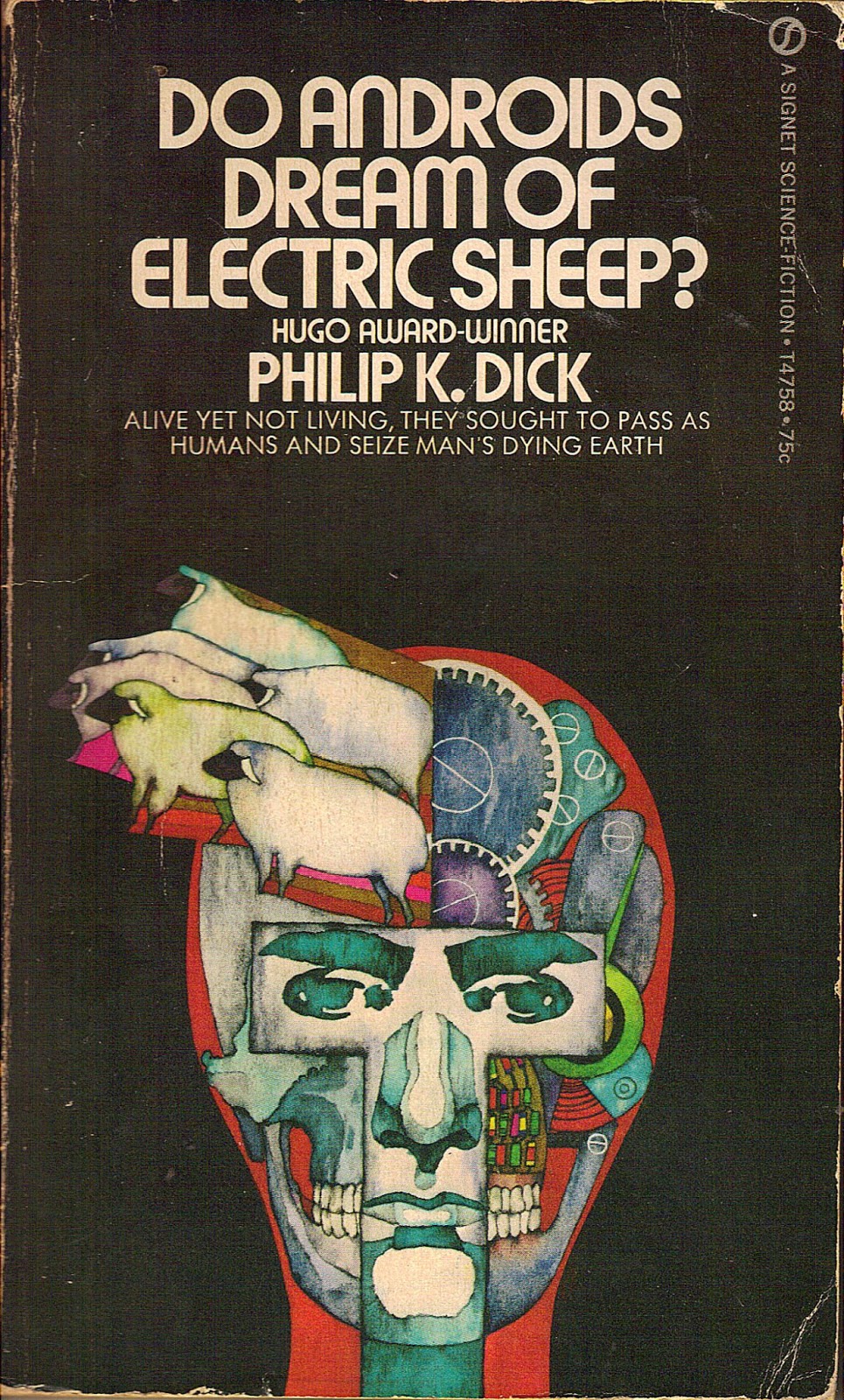
9/14 “’Then,’ Miss Luft said, ‘you must be an android.’” (Dick 101)
This sentence, although short, gives insight into a large core meaning to the novel. The context of the situation is after Rick claims that androids do not care about other androids, Miss Luft response with that statement. It plays into the true meaning of what is human and according to the whole story the answer is empathy. This shows that if Rick were truly a human, he should have remorse and empathy for the androids he has killed whether or not they are organic. The androids are shown to be sentient which is more than many argue for the animals that are so cherished on this version of Earth. Rick creates a paradox in identifying androids as lacking empathy while he himself is selective with his own empathy. This is further proven by the faux police department filled with androids that look after each other showing that androids at their given capacity may have more empathy than even humans. This challenges the difference between humanity and machines, causing the lines to be blurred where the test can no longer be said to stand for empathy, merely just a physical reaction. The novel uses this theme to demonstrate the dangerous mentality of paranoia during the cold war. The androids were likely used to show communists, where although they are fundamentally different because of their bodies (the androids) or their ideologies (the communists), they are the same as everyone else. People were worried that communists were hiding all around ready to strike and topple the government. Because communists (or androids in the context of the book) seemed just like everyone else, it was impossible to tell who was a communist or a regular American. This is the very intention of not only the sentence, but the entirety of the novel. Luba Luft’s name should also be considered. Later in the novel love is boiled down the word sex when accounting for Rick’s feelings towards Miss Luft dying. It only accounted for the physical attraction Rick feels, but Luft’s character was written as witty and smart finding cleverly maneuvering around the test questions, having interest in the arts, and giving Rick and Phil deep self-reflection with Rick’s biggest reflection being due to the quoted sentence. The last name Luft must have intentionally been close to the word lust to draw out the sexual desires of Rick and his feelings towards something he deems an object. This could also help emphasize Luft believing or at least accusing Rick of being a “sexual deviant” and the true nature of his visit. This sentence served a large self-reflection for Rick and for the audience on why empathy should not be spread to machines once a certain level of intelligence is reached. Luft who helped demonstrate Rick’s attraction to Luft helped bridge the gap between human and android which parallels to communists being human even though they were feared. If someone can fall in love with a capitalist, they can fall in love with a communist, which many people didn’t understand in the cold war.
A picture of the Andromeda Galaxy
10/5 “My ideas are simple—the more beautiful I find my planet, the more I get to love it, the more I want to serve it, to plant gardens, extract metals, produce power and food, create music, so that when I have passed on my way I shall leave behind me a little piece of something real made by my hands and my head” (Yefremov 63)
This quote is spoken by Erg Noor in response to a comment about the patriarchy before communism. This quote seemed to convey very communistic thoughts and helps show the ideology behind it. Erg shows that with his love, he wishes to take care of and give to his planet. It is akin to the ideas of communism where one should love one’s country and work hard to give back to it for the betterment of everyone. This is a foil to capitalism where people do what is best for themselves and not for everyone else. The idea of love being shown in things such as planting gardens, harvesting metal and producing power and food seems foreign to many of us because the system in which we live is geared towards ourselves and not for the benefit of everyone. This shows a good example of the didactic nature of the USSR’s literature during the cold war. It shows that the commoners should work for their country while also being able to enjoy the pleasantries of activities such as music making. The final part of the sentence of creation of something with Erg’s head and hands and leaving it behind when he dies is also a capitalistic feeling but it is understood differently. Often people in capitalist society dream of making a mark on the world and being remembered either by being famous for the arts, success, or kindness. The socialist approach to this remark is that Erg wants to leave something for his world and country that future generations can use and appreciate. He wants to honor his people and planet by making his existence beneficial for the planet and society. The sense of wanting to make something to be remembered by in capitalist society is inherently selfish by wanting to be remembered for being great, not for being helpful.